AI SEO Agency: What It Is, What It Costs, and How to Choose One
Discover what an AI SEO agency does, typical pricing, and how to pick the right one for your site, see the key questions to ask before you hire.
Read →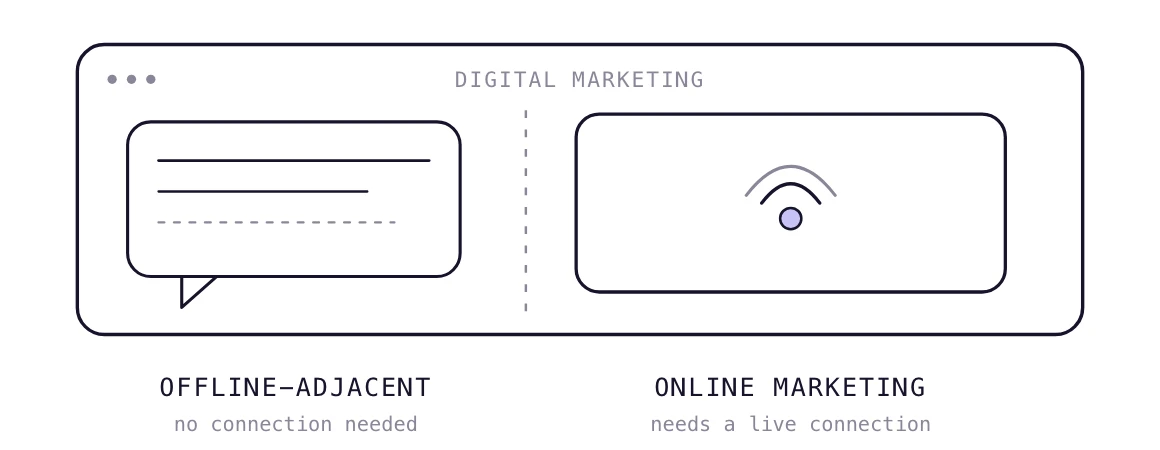
Online marketing and digital marketing are not the same thing, even though the two terms get used interchangeably in most conversations. Digital marketing is the broader category. It includes any promotional activity delivered through an electronic device, whether or not that device is connected to the internet, covering channels like SMS campaigns, digital billboards, and in-store kiosks alongside internet-based advertising. Online marketing is a smaller category inside it. It only includes activity that requires a live internet connection, such as search ads, social posts, and email sent through a web platform. Every online marketing tactic is digital marketing, but not every digital marketing tactic is online marketing.
Digital Marketing - Digital marketing is any promotional activity carried out using electronic devices or digital technology, whether online (connected to the internet) or offline.
Online Marketing - any promotional activity that requires a live internet connection to reach its audience.
The dividing line is simple: does the channel need internet access to function? SMS blasts and digital signage don't. Search ads and social campaigns do, and that single test resolves most of the confusion between the two terms.
No, online marketing is not the same as digital marketing. It is one category that sits inside the larger digital marketing category.
A retailer sending a text-message coupon is running digital marketing, since SMS is a digital channel, but it isn't online marketing because no internet connection carries the message. The same retailer running a Google Ads campaign is doing both online marketing and digital marketing at once, since paid search needs a live connection to serve the ad and record the click.
The confusion started because online marketing came first. Agencies in the early 2000s used it to describe every internet-based tactic, back when SMS campaigns and digital billboards weren't part of anyone's marketing conversation yet, and 'digital' mostly referred to computers themselves.
As non-internet digital channels grew more common, marketers needed a wider term to cover all of it, and 'digital marketing' took over as the umbrella label. Many people never updated their vocabulary, which is why the two terms still get swapped in casual conversation today.
Digital marketing is the umbrella term for any marketing that runs on an electronic device or digital channel, connected to the internet or not. It spans internet channels like SEO and paid search plus offline-adjacent formats like SMS and digital out-of-home screens.
Global digital ad spend is projected to top $950 billion this year, according to Statista's advertising forecast (February 2026). Many teams now plan AI search optimization alongside traditional paid search inside that same budget.
Most teams still plan budgets around a channel list from ten years ago. The line worth drawing today is connected versus disconnected reach, not online versus offline.
Online marketing is any promotional activity that only works with a live internet connection. If the channel stops functioning the moment Wi-Fi or mobile data drops, it counts as online marketing.
Common online marketing channels include SEO, pay-per-click ads, email sent through a web platform, social media marketing, and affiliate marketing. All five require an active internet connection to reach anyone, and all five stop producing results the moment that connection is lost.
The core difference is scope. Digital marketing includes online marketing plus offline-adjacent digital channels that don't need an internet connection.
PilotDeck treats this split as a planning question, not a vocabulary debate: which channels in a client's mix depend on a live connection, and which don't.
| Factor | Digital Marketing | Online Marketing |
|---|---|---|
| Scope | All digital channels, online plus offline-adjacent | Internet-only channels |
| Needs live internet | No | Yes |
| Example channels | SMS, digital billboards, SEO, PPC | SEO, PPC, email, social ads |
| Best measured by | Channel-specific KPIs across the full mix | Web analytics: clicks, sessions, conversions |
| Typical owner | CMO or marketing director, across all channels | Digital marketing manager or SEO/PPC specialist |
| Works without Wi-Fi or data | Yes, for offline-adjacent channels | No, connection loss stops the campaign |
Digital marketing is the strategy umbrella; online marketing is the execution layer inside it. Plan budget at the digital level, then allocate spend by channel.
Digital marketing splits into eight channel types that most marketing teams track separately. Six of them only work with an internet connection; the other two can run without one.
Digital channels now account for roughly 69% of total global ad investment, according to Dentsu's global ad forecast (December 2025). Only the first six types on that list qualify as online marketing; the last two can run without an internet connection.
Use 'digital marketing' in strategy documents and job titles, since it covers the full channel mix stakeholders expect to see. Use 'online marketing' only when describing internet-only tactics like SEO, PPC, or email, since that phrasing signals a narrower, internet-dependent scope.
PilotDeck's team defaults to 'digital marketing' in client reporting for this reason, then breaks channels into online and offline-adjacent buckets underneath it. "Once you drop the offline-versus-online split and think in terms of connected reach, budget conversations get sharper," says Alpesh D., Co-founder at PilotDeck.
A B2B SaaS company running SEO, paid search, and email should use 'digital marketing' in strategy decks and reserve 'online marketing' for the internet-only slice of that same plan.
Digital marketing is the category; online marketing is the internet-dependent slice inside it. Use 'digital marketing' when describing a full channel strategy, and reserve 'online marketing' for the tactics that stop working the moment the connection drops.
Getting this distinction right matters more for internal alignment than for search rankings. A shared definition keeps budget conversations, job descriptions, and reporting dashboards consistent across a marketing team, agency, and client.
SEO is both. It's a form of online marketing because it needs an internet connection to work, and it's also digital marketing since that's the broader category every online marketing tactic belongs to. The same logic applies to PPC, email, and social media marketing.
Traditional broadcast TV and radio are not digital marketing unless delivered through a digital format, such as connected TV (CTV) ads or digital radio streams. Analog broadcast falls outside both categories entirely, since it uses neither a digital device nor an internet connection.
Yes, technically, but it's uncommon. Most businesses running SEO or paid ads also use at least one offline-adjacent digital channel, like SMS or a digital receipt program, which puts them in the digital marketing category by default.
Neither term determines cost by itself. Cost depends on the specific channels chosen, the industry, and the market, not on whether those channels fall under the online or digital marketing label.
"Internet marketing" and "online marketing" are used as synonyms industry-wide, both describing promotional activity that depends on an active internet connection to reach an audience.
Most job titles use "digital marketing" (Digital Marketing Manager, Digital Marketing Specialist) since the role usually covers offline-adjacent channels too, not just internet-only tactics. Titles built around a single online channel, like "SEO Specialist," are the exception.

Co-founder, PilotDeck
Alpesh builds the growth engine behind PilotDeck. He has spent years helping startups go from zero traffic to steady organic growth, and now brings SEO, GEO, AI automation and content strategy together in one repeatable system that also gets brands named in AI answers.
Discover what an AI SEO agency does, typical pricing, and how to pick the right one for your site, see the key questions to ask before you hire.
Read →
Compare Grok vs ChatGPT in 2026 and find out which AI assistant is better for research, writing, coding, real-time information, reasoning, and daily tasks.
Read →
Compare Copilot vs ChatGPT and answer: Is Copilot the Same as ChatGPT? Learn the key differences in features, models, integrations, and use cases.
Read →Hand over a domain. Research runs and your first article is written within the hour.
Start free trialCancel any month. Your site and content stay yours.