AI SEO Agency: What It Is, What It Costs, and How to Choose One
Discover what an AI SEO agency does, typical pricing, and how to pick the right one for your site, see the key questions to ask before you hire.
Read →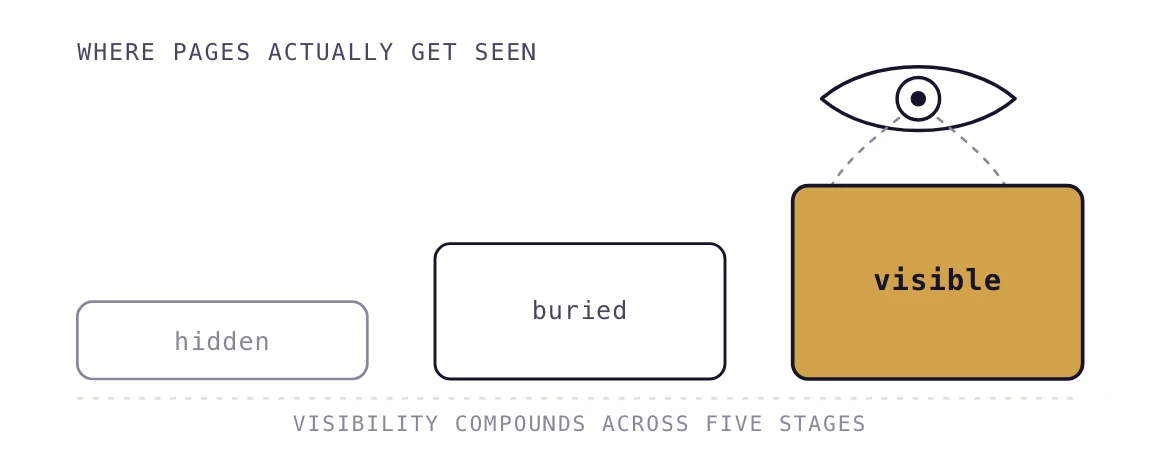
Getting more visibility on Google is not about finding one SEO trick and repeating it. Search rankings depend on how well your website works, how closely your content answers what people are searching for, how much authority your site has, and how clearly Google can understand your pages. The strongest results come from improving these areas together rather than treating them as separate tasks.
You increase search engine visibility on Google by fixing technical foundations, matching content to search intent, structuring pages for AI Overviews and featured snippets, earning backlinks, and strengthening local and multi-channel signals. Then tracking the results. No single tactic moves rankings alone. Visibility compounds when these changes stack together and stay maintained over time.
Search engine visibility measures how often and how prominently your pages appear across Google Search, AI Overviews, and other SERP features for the keywords your audience searches for. It differs from rankings alone: a page can rank third and still stay invisible if AI Overviews or featured snippets push it below the fold. High visibility means a consistent presence across multiple SERP formats not one blue-link position.
| Stage | Strategies | Primary Goal |
|---|---|---|
| 1. Technical Foundations | Core Web Vitals, mobile-first indexing, crawl/index health | Get pages crawled and rendered fast |
| 2. Content & E-E-A-T | Intent matching, named authorship, scheduled refreshes | Prove trust and match intent |
| 3. AI-Ready Structure | Answer-first sections, eligible schema, extractable formatting | Get cited by AI Overviews and LLMs |
| 4. Authority & PR | Original-data links, digital PR, unlinked-mention recovery | Earn real backlinks and mentions |
| 5. Local & Multi-Channel | Google Business Profile, location pages, social/video distribution | Extend visibility beyond one domain |
Google can't rank pages, it can't crawl, render quickly, or serve cleanly on mobile, so technical health comes before content or link work. Google itself recommends good Core Web Vitals scores for search success, according to Google Search Central (2026), since these metrics measure real-world loading, responsiveness, and visual stability.
Content earns visibility when it matches what the searcher wants and demonstrates real experience, expertise, authority, and trust - what Google calls E-E-A-T. Intent match and E-E-A-T work together: the right format ranks, but only a credible source keeps that ranking through updates.
At PilotDeck, every client article carries a named, credentialed byline for exactly this reason - anonymous "Team" bylines rarely hold up under E-E-A-T scrutiny once a page is competing for a commercial keyword.
Most sites don't lose visibility because of one big mistake. They lose it by skipping the boring technical work and expecting content alone to carry rankings.
Google's AI Overviews and LLM answer engines pull short, self-contained answers, so structure every section to answer its own question in the first sentence, then expand below it.
Keep detailed FAQ content on the page even without the rich-result dropdown. It still feeds AI Overviews, ChatGPT, and Perplexity answers, none of which depend on that specific schema feature to cite you.
Tools like AI citation analysis tools show which of your pages already get cited by AI engines, so you can replicate the formatting pattern that's working elsewhere on your site.
Backlinks and brand mentions remain among the clearest authority signals Google has, so earning them from relevant, real sites beats any shortcut or bulk-outreach tactic.
Buying links from link farms or mass guest-post networks. Google's spam systems catch the pattern quickly, and the resulting penalty can erase months of legitimate link-building work.
PilotDeck's own case studies track this same kind of link and mention growth for client sites over multi-month campaigns.
Google increasingly blends Maps results, local packs, and social content into standard search results, so local and cross-channel signals matter even for businesses that aren't purely local.
Track visibility with Search Console impressions and average position, a keyword rank tracker for your priority terms, and AI visibility tracking tools that check whether ChatGPT, Gemini, and Perplexity mention your brand. Review Search Console weekly, watch backlink growth monthly, and re-run the AI-citation check quarterly so you catch both traditional and AI-driven visibility shifts.
Increasing search engine visibility on Google is not one fix - it's five stages working together, tracked consistently over months rather than days. Start with the technical foundations, layer in intent-matched E-E-A-T content, structure sections for AI Overviews, then build authority and local presence around what's already working.
Most sites see measurable movement within 8 to 12 weeks after fixing technical issues and publishing intent-matched content, with gains compounding over 6 to 12 months as authority builds.
Rankings track one keyword's position. Visibility tracks your total presence across every keyword, SERP feature, and AI answer engine combined.
Yes. Earned links from relevant, real sites remain one of Google's clearest authority signals, though topical relevance now counts for more than raw link volume.
No. AI Overviews reduce clicks for simple factual queries, but they still cite sources, and complex or commercial searches continue driving traffic to full pages.
Refresh core pages every two to three quarters. Update statistics, examples, and internal links so each page keeps matching current search intent.
It's less critical, but not irrelevant. A complete Google Business Profile and location pages still help software and service brands rank for regional buyer searches.

Co-founder, PilotDeck
Jignesh (JC) brings years of experience in software development, building scalable web applications and data-driven products. He leads the engineering behind PilotDeck, turning AI and emerging technology into practical tools that help businesses get found.
Discover what an AI SEO agency does, typical pricing, and how to pick the right one for your site, see the key questions to ask before you hire.
Read →
Compare Grok vs ChatGPT in 2026 and find out which AI assistant is better for research, writing, coding, real-time information, reasoning, and daily tasks.
Read →
Compare Copilot vs ChatGPT and answer: Is Copilot the Same as ChatGPT? Learn the key differences in features, models, integrations, and use cases.
Read →Hand over a domain. Research runs and your first article is written within the hour.
Start free trialCancel any month. Your site and content stay yours.